




PWP Power Projects
PWP’s diverse power supply mix comes from renewable and/or carbon free resources (solar, wind, landfill, geothermal, hydroelectric, and nuclear), natural gas, and the wholesale energy market.
A list of resources, by type and service start date, is shown below.
SOLAR | WIND | GEOTHERMAL | LANDFILL GAS | NUCLEAR | HYDRO |
NATURAL GAS | STORAGE
RENEWABLE ENERGY
SOLAR

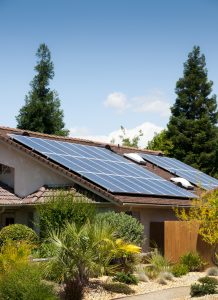
Windsor Reservoir Solar Project (2011) PWP’s earliest solar project was the installation of a 645 kilowatt (kW) photovoltaic solar generator on the roof of Pasadena's Windsor Reservoir facility. The system generates approximately 872 megawatt-hours (MWh) of renewable energy annually, which helps offset utility costs and reduces customer water bills. |

Columbia II Solar Project (2014) Pasadena receives a 17.143% share of the 15 megawatt (MW) Kern County, California solar plant through a 20-year agreement, which is active through 2034. |

Antelope Big Sky Ranch Solar Project (2016) Pasadena receives 32.5% of the output of the 20 MW solar project located near Lancaster, California. Antelope Big Sky Ranch achieved Commercial Operation Date (COD) in 2016. |

Summer Solar Project (2016) In 2014, Pasadena contracted for a 32.5% share of the 20 MW solar project located near Lancaster, California. Summer Solar achieved COD in 2016. |

Kingbird Solar Project (2016) In 2013, Pasadena executed a 20-year agreement with Kingbird Solar, LLC for 100% output of the 20 MW project located in Rosamond, California. Kingbird achieved COD in 2016 and provides approximately 50,000-60,000 MWh of solar power to Pasadena annually. |

Grace Orchard Solar III (Coming in 2027) PWP’s most recent solar investment, a 50 MW share of Grace Orchard Solar III, was secured through an agreement with Southern California Public Power Authority (SCPPA) in late 2024. The total output of the 170 MW Blythe, California generating facility will be shared with two other SCPPA members, with deliveries scheduled to begin in 2028. In addition to contributing to Pasadena’s clean energy goals, Grace Orchard Solar III will provide important replacement energy for contracts scheduled to terminate in 2027. |
|
Bonanza Solar plus Storage (Coming in 2028) Pasadena executed an agreement for 105 MW of solar and 55 MW of battery storage from the forthcoming Solar-Plus-Storage project. The overall 220 MW solar generating/115 MW battery facility in Clark County, NV will be shared with another utility and is scheduled to begin commercial operation in 2028. The Bonanza Project is forecasted to deliver 303,534 MWh to Pasadena annually. |

WIND

Milford Wind Corridor Phase 1 (2009) Pasadena executed a 20-year agreement in 2007 for a 2.5% share (approximately 5 MW) of the Milford Wind Corridor Phase I Project, a 203.5 MW wind farm located near Milford, Utah. The facility, which includes 97 wind turbines, began commercial operation in 2009 and represents Pasadena’s earliest wind energy investment. |

CalWind Resources Inc. (2025) Pasadena contracted with CalWind Resources, Inc. for 20 MW from Wind Resource II – Pajuela Peak, in Tehachapi, CA. The project was recently repowered to modernize its turbines and Pasadena expects to receive 60,000 MWh annually through the 10-year agreement beginning in 2025. The CalWind Resource I location is operational and has been providing energy to Pasadena through various short-term agreements since 2023. |
GEOTHERMAL

Coso Geothermal (Coming in 2027) Through a 15-year agreement, Pasadena will receive energy from the Coso geothermal plant in Inyo County, California starting in 2027. Specifically, 10.37 MW (maximum) in years 2027 through 2036, increasing to 19.36 MW in years 2037 through 2041. The 145 MW facility began commercial operations in 1987. |

Geysers Geothermal (Coming in 2027) Pasadena recently executed a 15-year agreement for 25 MW of geothermal energy from Geysers, LLC. The 725 MW Middletown, CA complex includes multiple power plants and operates on the largest geothermal fields in the world. Geysers is expected to deliver 194,910 MWh of energy annually to Pasadena, starting in 2027. |
LANDFILL GAS

Puente Hills Landfill Gas-to-Energy (2017) Pasadena has been receiving approximately 30% of the output from the 43 MW Puente Hills Landfill Gas-to-Energy Project in Whittier, CA, since 2017. |
CLEAN ZERO-CARBON ENERGY
NUCLEAR

Palo Verde Nuclear Generating Station (1981) Pasadena contracted for a 4.4% share (approximately 10 MW) of SCPPA’s 225 MW share the 4,003 MW (maximum capacity) Palo Verde Nuclear Generating Station, located in Maricopa County, Arizona. Other SCPPA participants include the cities of Azusa, Banning, Burbank, Colton, Glendale, Los Angeles, Riverside, Vernon, and the Imperial Irrigation District. The 3-unit facility was commissioned in 1986 and 1987 and provides Pasadena with approximately 65-75 gigawatt-hours (GWh) of baseload energy annually. |
HYDRO

Hoover Hydroelectric Project (1936) In 1932, Pasadena entered into the first of two agreements with the United States Department of Energy/Western Area Power Administration for a combined total of up to 20 MW capacity from the historic Hoover Hydroelectric Project, located at the Hoover Dam in Black Canyon, NV. Under normal conditions, Pasadena can expect to receive approximately 60 GWh of energy annually from Hoover, although the available capacity varies, depending on hydrologic conditions, maintenance scheduling, and other outages. |

Azusa Hydroelectric Plant (1933) The Azusa Hydroelectric Plant, a 3 MW facility owned by the City of Pasadena and located in the San Gabriel River Basin in Azusa, California, has historically delivered approximately 3 GWh of energy annually to Pasadena since it was acquired from Southern California Edison in 1933. However, production has largely ceased in recent years due to ongoing regional drought conditions. In 2013, PWP completed a seismic retrofit of the penstock and by-pass pipe, in compliance with current seismic code. |
CONVENTIONAL POWER
NATURAL GAS

Glenarm/Broadway Power Plant (1906) Pasadena’s community-owned power plant, which has been operating for well over a century, is located on a 14-acre site in the southwestern portion of Pasadena city limits. The site consists of two groups of generating facilities, one of which is operational today, with a collective output rating of 197 MW. In 2016, PWP completed the Glenarm Repowering Project, an extensive efficiency upgrade, that added approximately 70 MW of capacity to support local electric reliability. |

Magnolia Power Plant (2005) Pasadena has been a participant in the Magnolia Power Project since 2003 through an agreement with SCPPA. The, Burbank, California gas-fired generating facility has a maximum rated net capacity of 242 MW, and Pasadena owns a 6.1% share (about 19 MW maximum capacity). The agreement terminates in 2036. |

Intermountain Power Project (1986) Participants of the Intermountain Power Project (IPP) include the cities of Los Angeles, Anaheim, Burbank, Glendale, Pasadena, and Riverside; PacifiCorp; 23 Utah municipal members; and six rural electric cooperatives. IPP is currently repowering from coal to natural gas with completion expected by mid-2025. While Pasadena is entitled to a 54 MW share of the new 840 MW Delta, Utah facility, its contract will terminate without renewal in mid-2027. |
STORAGE
| Glenarm Battery Energy Storage System (Coming in 2026)
Development of Pasadena’s first utility-scale Battery Energy Storage System (BESS) is underway and expected to be operational in 2026. The 25 MW 4-hour lithium iron phosphate battery, which will be located adjacent to the Glenarm Power Plant, will help store excess solar energy generated during the day so it can be redirected to support evening peak hours. The BESS is the first of various projects that Pasadena will pursue as part of its ongoing decarbonization efforts. |


